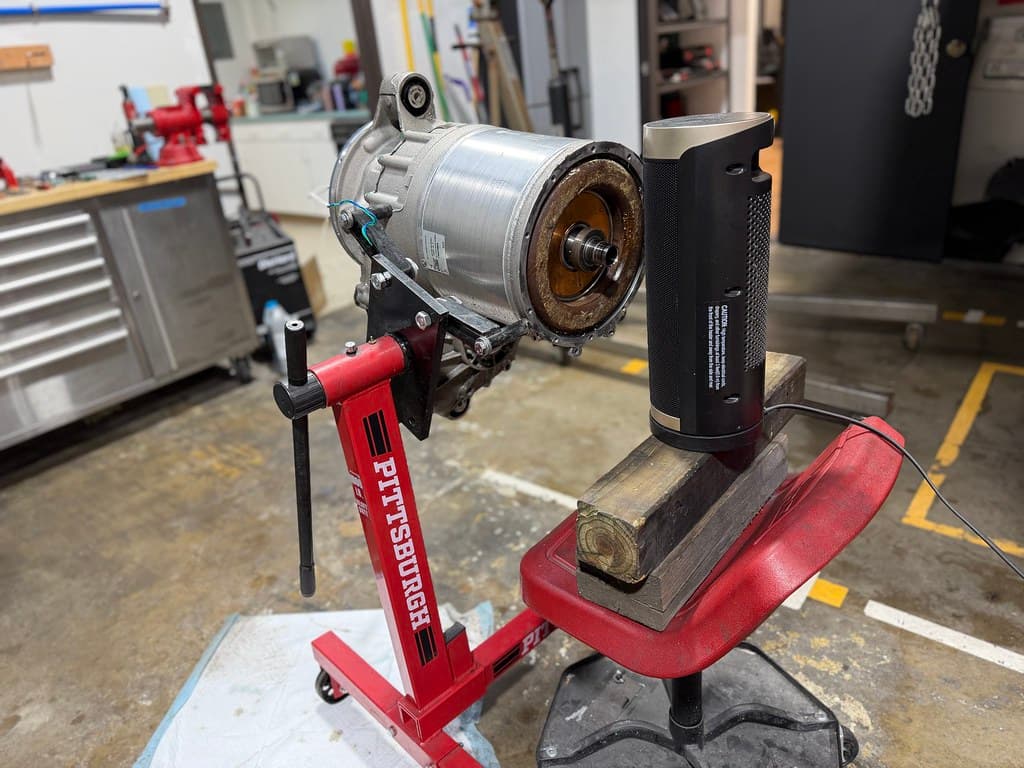
Here at AutoCarbon we rebuild numerous Tesla Large Drive Units (LDUs) from early Model S and X vehicles. These units, found in 2012–2020 rear-wheel-drive and performance models, are prone to several common failure modes due to design flaws, particularly internal coolant leakage.
Common LDU Failure Modes.
Rotor spline failure – Often seen in early units due to insufficient factory-applied grease between the rotor spline and the primary input shaft, leading to fretting, corrosion, and premature wear. Rusty deposits from bearing corrosion can also accelerate spline damage.
Inverter flooding – Coolant leaks into the inverter cavity, causing electrical shorts and permanent damage.
Isolation breakdown – Coolant intrusion at the rotor seal leads to reduced insulation resistance, often triggering faults.
Whining rotor bearings – Coolant flushes out grease, accelerating wear and noise.
We perform complete overhauls, including replacing all eight bearings, new internal oil seals, axle seals, and a coolant delete at the manifold to prevent future leaks. During every rebuild, we thoroughly clean the rotor spline and primary input shaft mating surfaces and apply genuine OE-specified grease to ensure proper lubrication and prevent spline wear.
A Successful Recovery Case: Acting Fast Saved Thousands
Recently, we handled a critical case where the vehicle completely lost drive power with the error code "No available drive units" — indicating a communication failure at the inverter, often linked to coolant intrusion. Through remote diagnostics, we suspected coolant ingress and urged the customer to bring the car in immediately. We knew from experience that prolonged exposure allows corrosion to worsen, potentially making the unit unrecoverable. The customer acted quickly — within days — and we inspected:
-The encoder sensor showed minimal coolant presence (far less than typical severe cases).
-The HV cable cover had no visible moisture.
-No isolation faults were present initially.
-In this clients car we also observed corrosion from a failed inverter seal and minor leaks into the stator windings.
An isolation test revealed resistance at 3 MΩ (below the expected 4 MΩ or higher). We pulled the unit for a deeper inspection. Upon removing the inverter cover, we found the entire inverter coated in water droplets (not blue coolant, indicating condensation or minor intrusion). We disconnected plugs, cleaned with DeoxIT and electrical contact cleaner, and blew out connections with pressurized air. The inverter and rotor cover were placed under heat for two days. Insulation testing showed improvement: from ~20 MΩ on day one to 100 MΩ at 500V by day two. After reassembly and retesting with the inverter installed, isolation reached 4.3 MΩ — safely in spec! This quick intervention saved the LDU from total replacement, which costs $5,000–$7,000 in California. The customer's repair totaled just $2,700, backed by our 2-year/unlimited mile warranty.
Any Unit that leaves our shop leaves with a coolant delete!
Coolant Delete: Pros, Cons, and Our Approach There are differing views on the coolant delete mod:
European shops often prefer sealing to original specs with upgraded seals. Tesla's stance — Recent remanufactured units (Revision U, introduced late 2023) incorporate a factory coolant delete, blocking rotor flow while maintaining cooling to the stator, inverter, and gearbox.
We align with Tesla's approach: the delete prevents catastrophic leaks without significant issues in normal driving. High-speed highway use (e.g., 100+ mph on autobahns) may stress bearings more, but for typical conditions, it's reliable.
While not all units can be saved, LDUs are resilient and fully rebuildable — even stator or inverter failures can be addressed individually.
Long-Term Outlook and Recommendations
Properly rebuilt LDUs with a coolant delete can keep going, if serviced every 150,000–200,000 miles, including bearing replacements, spline greasing, and initial delete. Key tip: Use OE or hybrid ceramic bearings on the rotor for high-RPM demands and to prevent arcing. If you're dealing with a Tesla LDU issue — noisy bearings, isolation faults, power loss, or spline-related concerns — early intervention is key!
Contact us at AutoCarbon for diagnostics and repairs. We're here to keep your Tesla on the road affordably and reliably.
Thanks for reading! If this helped you understand Tesla LDU maintenance and serviceability, share your experiences below. Have questions? Drop a comment — we're happy to help. 🚗⚡